

| Location | Humboldt-Forum in Berlin Palace |
| Date | 21.03.2026 |
| Occasion | Festival „Nouruz, Newroz, Nauroz“ |
| Festival Co-Curator / Curator of the Uzbek Part | Zukhra Rakhmatova |
| Artists | Dilfuza Qobilova with her “Milliy Meros” ensemble of the Uzbek State Philharmonic, dance master Malika Khaidarova, and others |
With around 9,000 visitors, the Navro’z festival at the Humboldt Forum became one of the year’s biggest cultural highlights. It created a cultural space that visitors could truly experience – a day that demonstrated how international cooperation can be put into practice. Berlin, already a city of diversity, was enriched by a tangible experience on this day. As a key player, we brought the culture of Uzbekistan to the stage of the Humboldt Forum. The project was organised under the leadership of the Humboldt Forum in collaboration with six other Berlin-based cultural associations, which showcased cultural aspects of Navro’z from other countries.
Navro’z – Experience Cultural Heritage
Navro’z is the New Year and spring festival celebrated by over 300 million people along the Silk Road. It is listed as part of UNESCO’s Intangible Cultural Heritage and has, for over 3,000 years, marked a new beginning: the equinox – the moment when nature and community alike awaken. At the Humboldt Forum, cultures from Central Asia, Iran, Afghanistan and Kurdish regions came together to present their perspectives on this shared heritage. Navro’z was brought to life: through music, movement and interaction.
The opening set a clear tone: the powerful sounds of the karnay and surnay opened up the space – both acoustically and atmospherically.
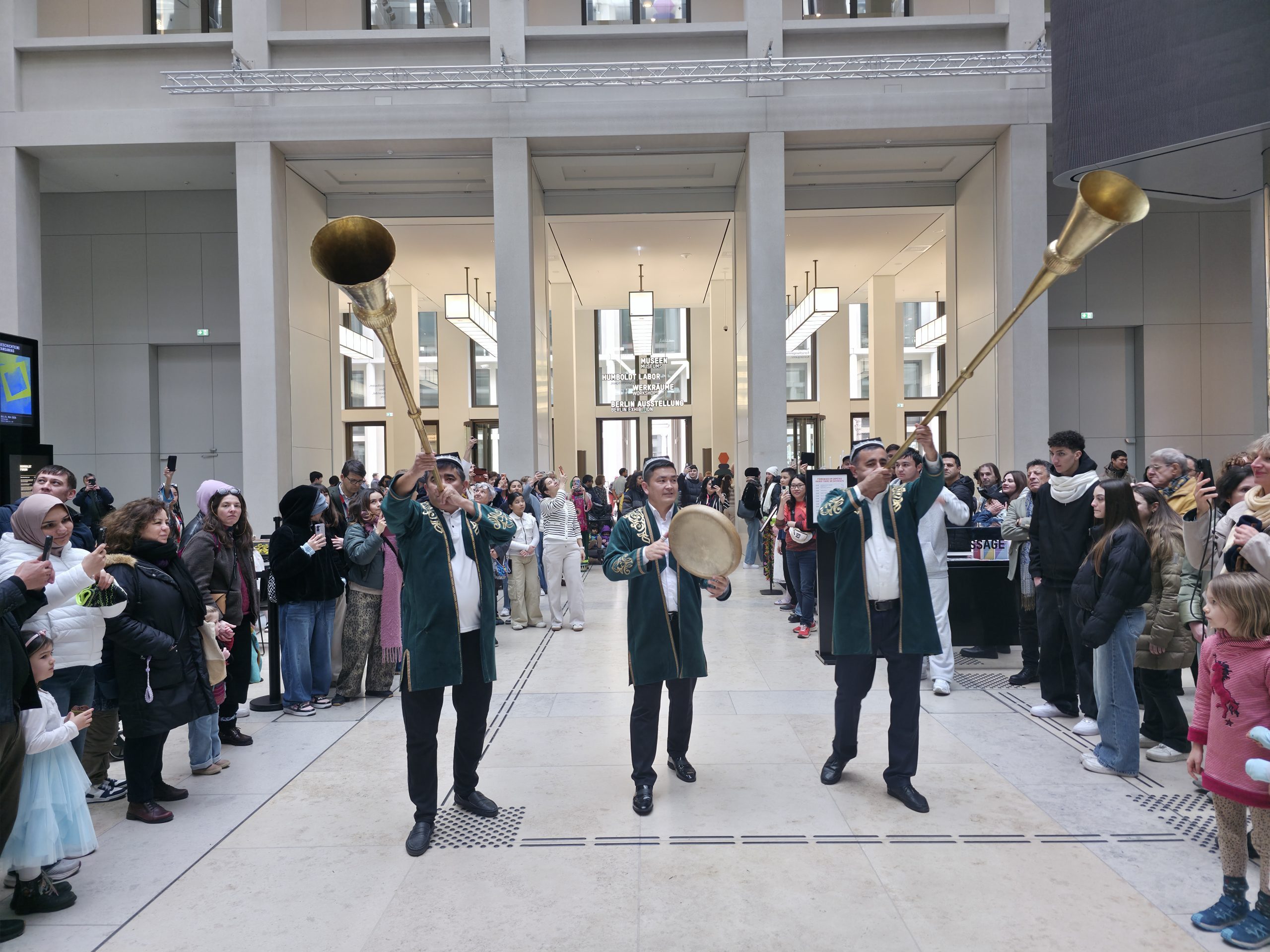
The Karnay and Surnay provided an acoustic highlight to set the scene
Program Highlights
On stage, traditional dance, song and musical virtuosity came together to create a multifaceted portrait of Uzbek culture. Renowned artists such as the master dancer Malika Khaidarova and the singer Dilfuza Qobilova embodied not only artistic excellence but also living tradition.
At the concert given by the singer Dilfuza Qobilova and her ensemble ‘Milliy Meros’ from the Uzbek State Philharmonic, traditional Uzbek folk music was performed live to mark Navro’z. All the performing artists are members of the Oʻzbekiston Davlat Filarmoniyasi (State Philharmonic of the Republic of Uzbekistan) – the country’s central state concert institution. They regularly represent Uzbekistan at official state events and at international cultural festivals.
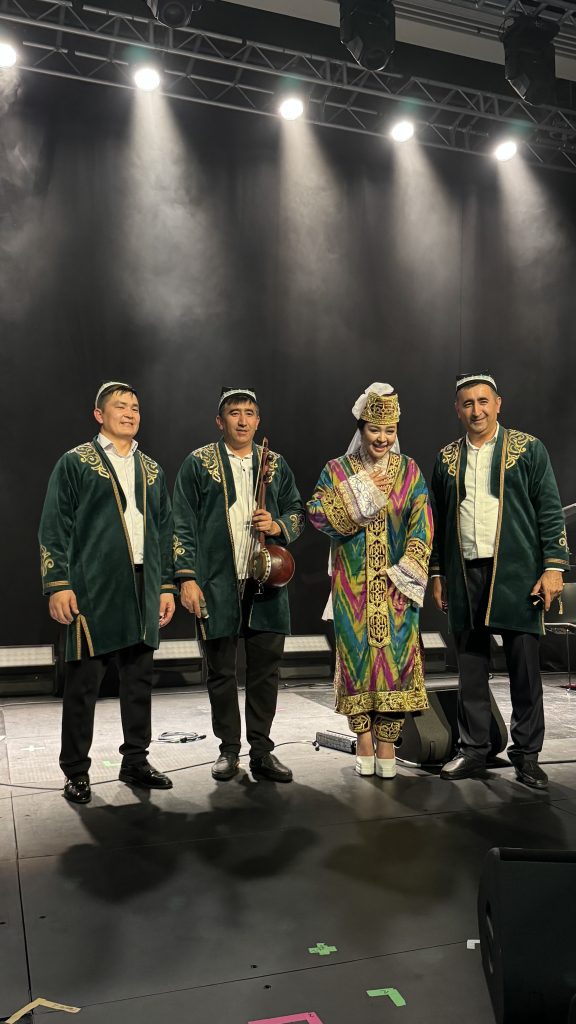
Performance by the Milliy Meros ensemble, conducted by Dilfuza Qobilova
The Uzbek musical tradition is shaped by centuries-old courtly and folk traditions. Instruments such as the karnay and surnay are closely associated with public celebrations, whilst maqam singing is one of the most sophisticated forms of classical music in Central Asia. The concert therefore offers not only musical performances, but also an encounter with cultural identity, historical continuity and contemporary interpretations of traditional art forms. The audience thus had the opportunity to experience the musical aspect of Uzbekistan’s cultural heritage and, in addition to the singing, to listen to the sounds of traditional instruments such as the karnay, surnay and doira.
Another definite highlight was the dance workshop with Malika Khaidarova – a lecturer and master of ethnic dance. During the workshop, participants were able to experience for themselves the magic of traditional Uzbek dances and thus get a taste of Uzbek Navro’z traditions. The Fergana style, traditionally danced by women and girls, was the focus of this workshop. The gentle elegance and inner presence of this dance embody a dignified, powerful, and subtle form of femininity. In addition to the fundamentals of the traditional Fergana style, the participants also gained insight into the traditional musical structure and contemporary interpretations of Uzbek dance.
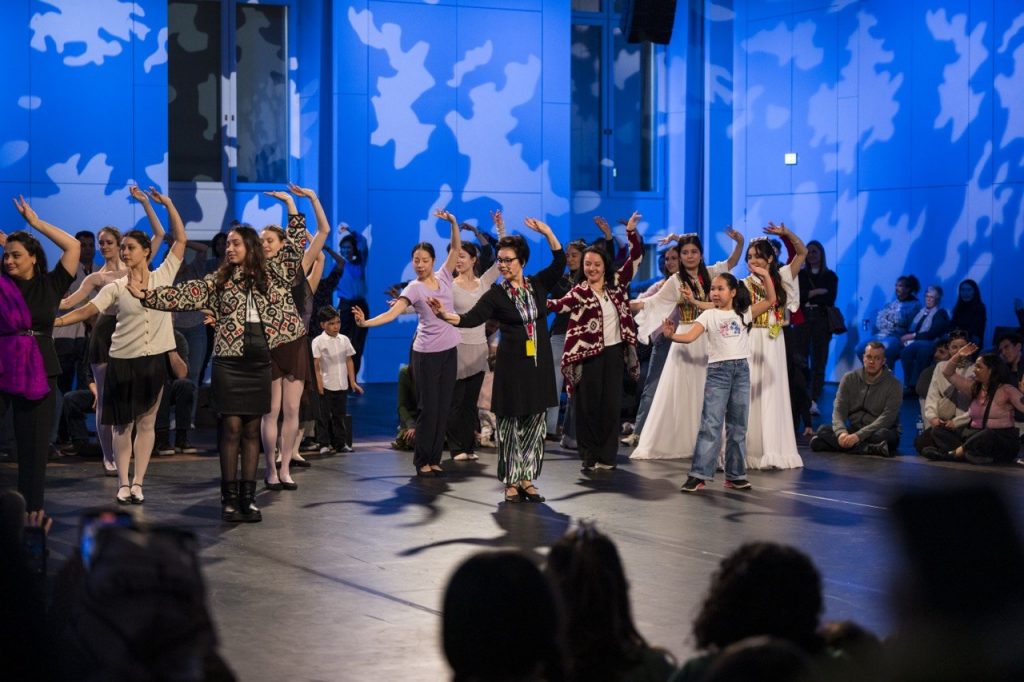
Dance Workshop with Malika Khaidarova
The festive atmosphere of the Spring Festival was further enhanced by a wide range of musical, theatrical, and dance performances celebrating the Uzbek traditions of Navro’z on the stage in the foyer. And the experience of Uzbek traditions went beyond the stage program: Children made kites, girls braided their hair, and families crafted flower wreaths.
In addition, there was a comprehensive workshop program for families. The workshop “40 Braids” (qirq kokil) teaches a traditional Uzbek art of hair braiding with deep-rooted symbolic meaning. The practice of braiding numerous fine braids while incorporating a special braiding ribbon, the “Jamalak,” has been widespread in Uzbekistan for centuries. It is considered an expression of beauty, femininity, and cultural identity. Weaving was also a social activity: mothers, grandmothers, and daughters gathered here. In this way, knowledge was passed down through generations—along with care, warmth, and family closeness. Preparing together strengthened family bonds and reinforced cultural values.
We also presented an intercultural family workshop on making traditional Uzbek kites—the varrak. Especially during Navro’z, flying kites becomes a ritual that spans generations: Children make their kites on their own or together with their parents and grandparents. Regardless of age or social background, a sense of community emerges that brings people together and celebrates the awakening of nature.
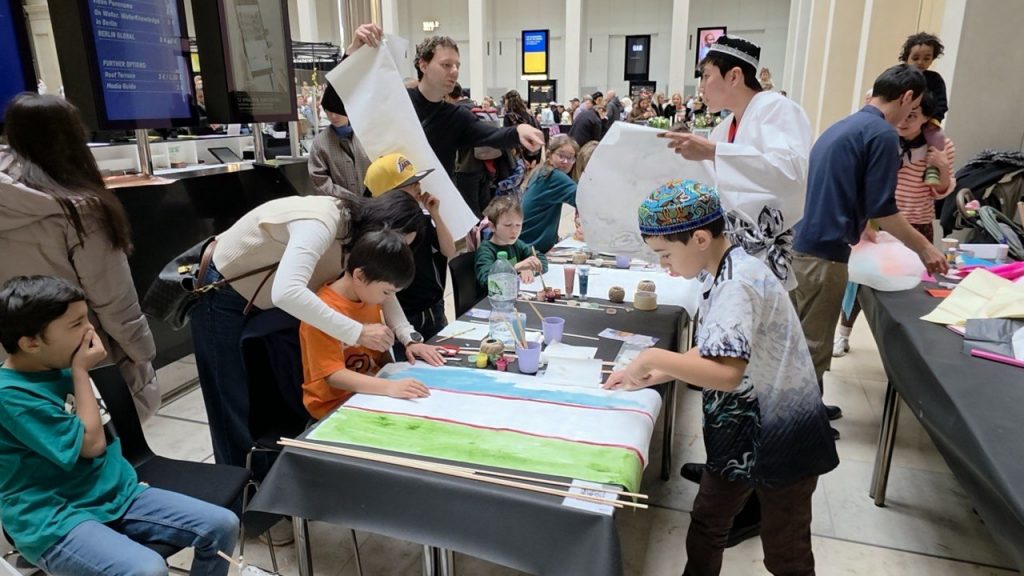
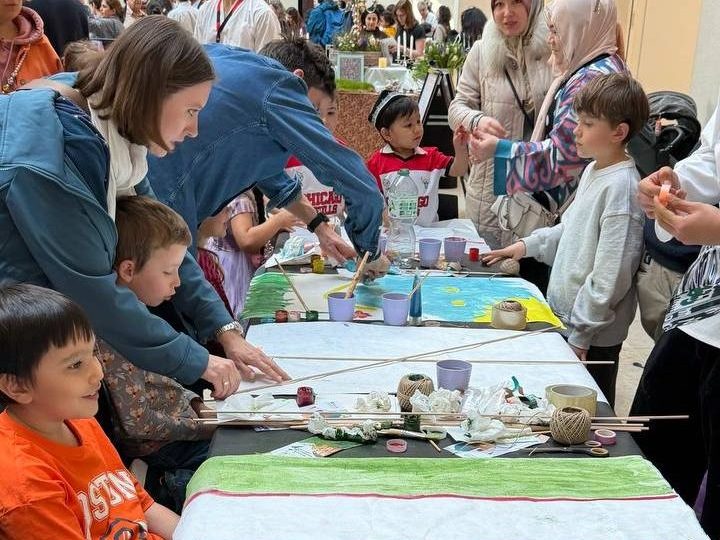
Kite Building Workshop
In another family workshop, participants wove “Gulchambar” flower wreaths, a vibrant, communal tradition. Weaving these wreaths from various flowers symbolizes the awakening of nature and the joy of the coming spring.
The event also featured a culinary program and a bazaar. In addition to the cultural highlights of Navro’z, the aroma of plov and freshly baked samsa invited visitors to sample traditional dishes. A bazaar showcased carefully selected traditional handicrafts, making them visible, tangible, and available for visitors to purchase.
Here, culture was embraced, explored, and shared. These contributions were part of a curated program that San’at e.V. had developed in advance. The internal planning shows how individual elements—music, dance, workshops, and audiovisual content—were deliberately interwoven to create a holistic experience.
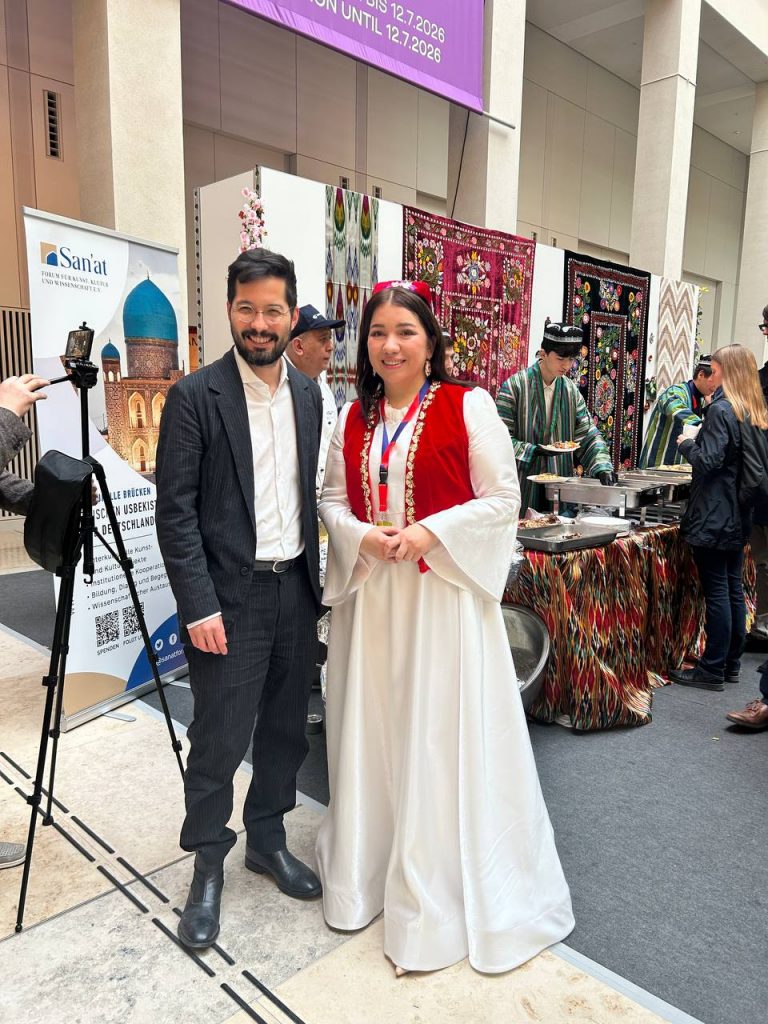
Han Song Hiltmann, Program Director of the Humboldt Forum, with our Chairwoman Zukhra Rakhmatova
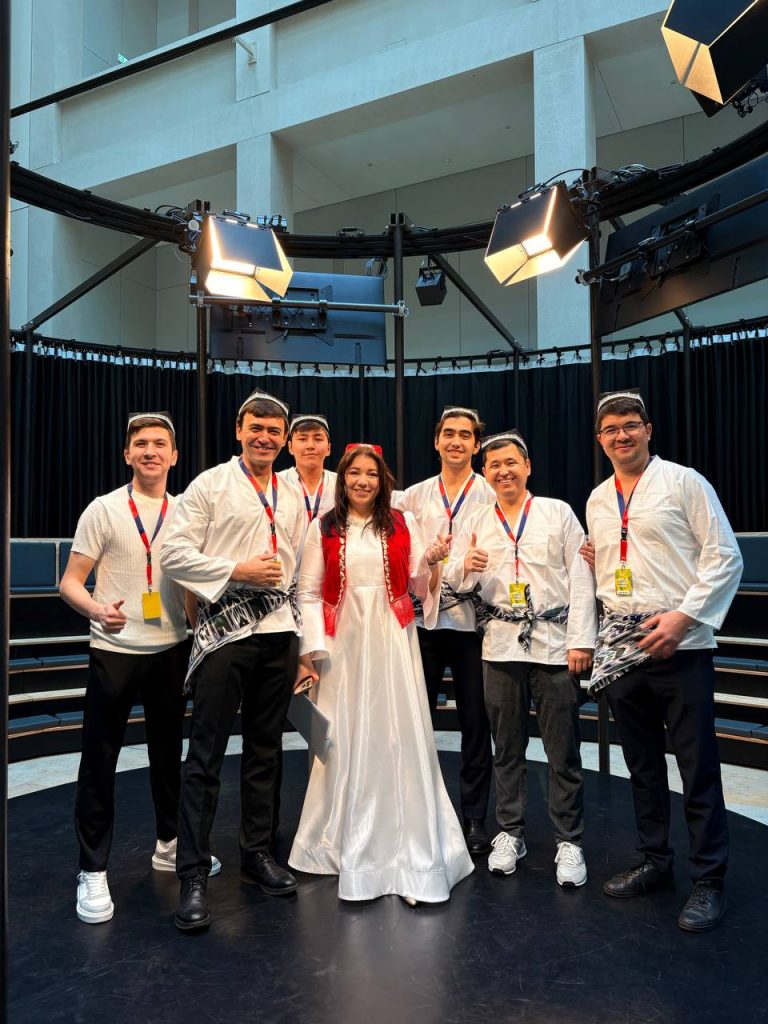
Our dance group, together with our chairwoman, Zukhra Rakhmatova
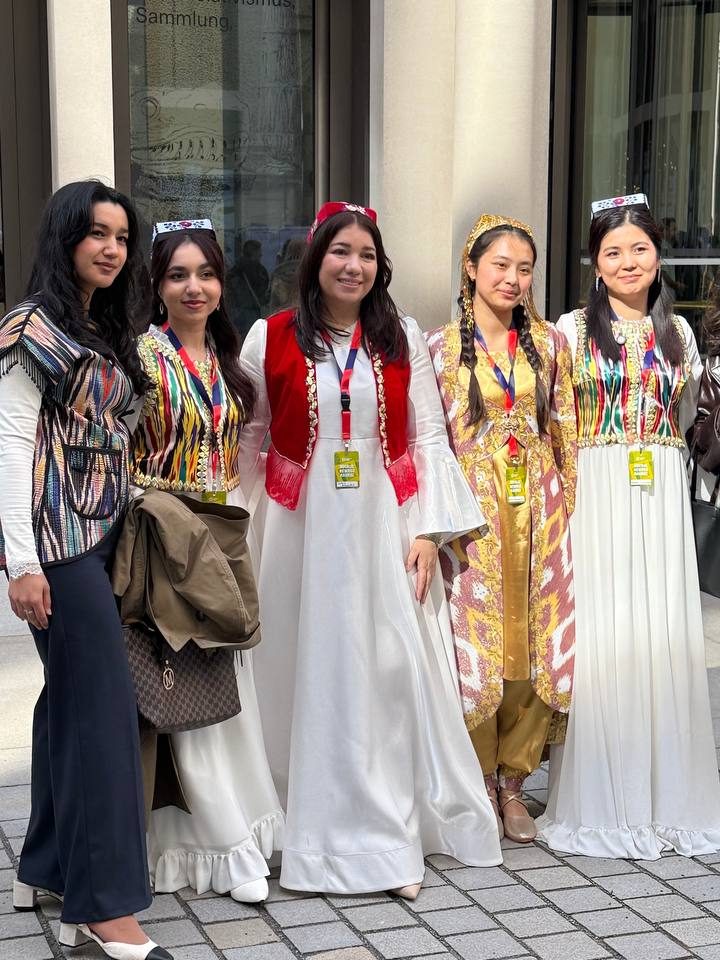
Our team from San’at Forum at the event at the Humboldt Forum
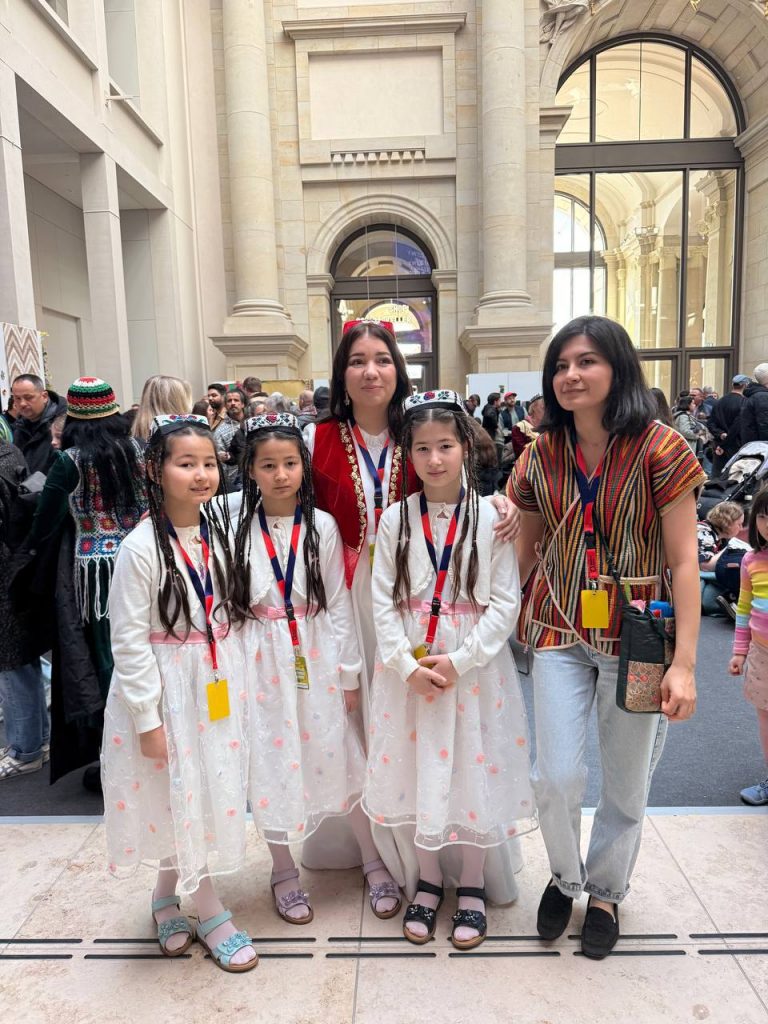
Our children’s dance group at the Humboldt Forum
Cultural Bridge-Builders and a Model for the Future
What made this day special—in addition to the individual program items—was the way the content was presented as living practice within the space: Conversations arose spontaneously—across generations, cultures, and backgrounds. Children explained what they had just learned to their parents, and visitors stayed longer than planned because new perspectives kept opening up. The festival became a social space: open, accessible, and inviting. It was a moment when the audience became active participants.
At the heart of this development was our association and our founder, Zukhra Rakhmatova, who served as the curator of a cultural dialogue. Her approach: not to present culture in isolation, but to view it as a unifying element—connecting countries, institutions, and people. Through collaboration with the Humboldt Forum and six other associations, a format was created that extends beyond a single day.
What remains is more than just the memory of a well-attended day. The Navro’z festival demonstrates the potential of formats that don’t just present but also engage. At a time when cultural exchange often remains abstract, this model offers a concrete answer: encounters arise where people actively participate. Perhaps that is precisely the true significance of this day—as a subtle hint at what cultural dialogue in European cities might look like in the future.
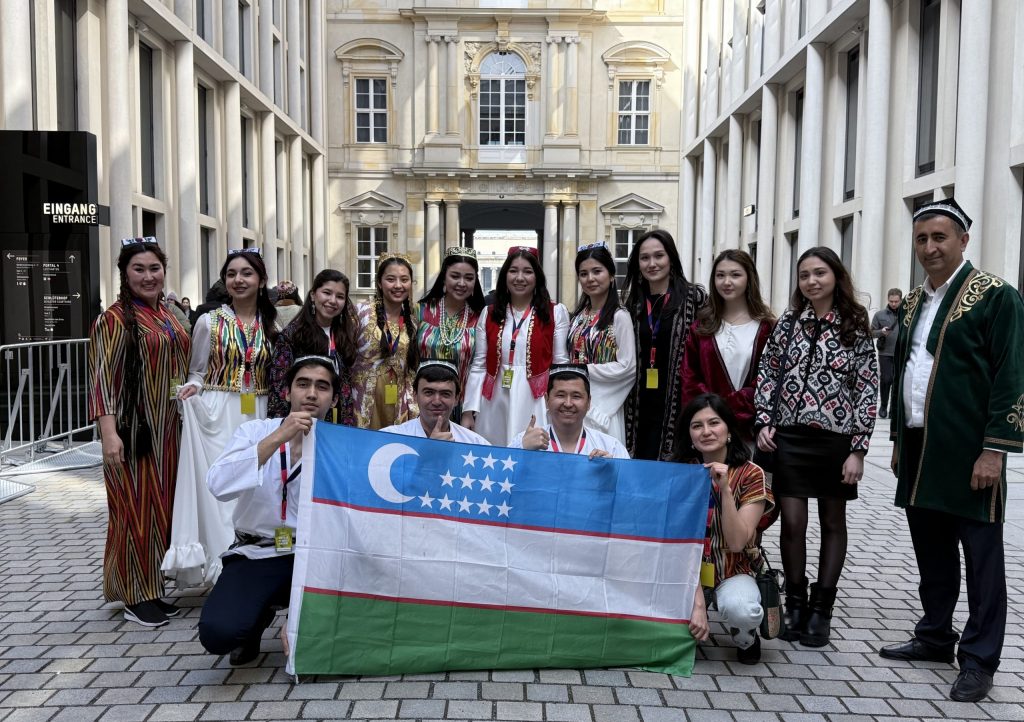
The San’at Forum e.V. team at the Humboldt Forum
Comments are closed